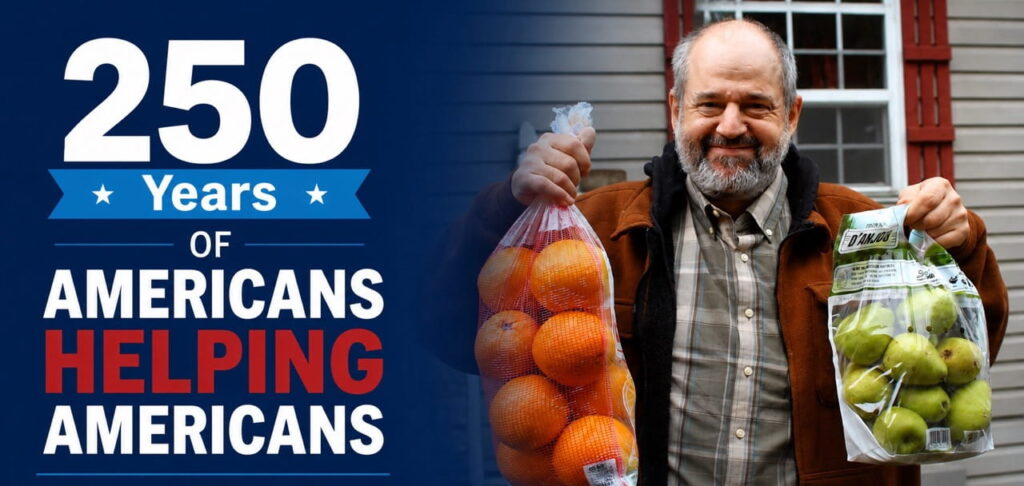

Since 1776, Americans have relied on their relatives, neighbors, and friends, charitable organizations (such as Americans Helping Americans®), and their communities at large to help them through the challenges our nation has faced throughout its history.
From the hardships of the Revolutionary War and the early years of building a new nation to economic crises, natural disasters, and times of uncertainty, Americans have repeatedly come together to help one another in times of need.
For the past 250 years, since the founding of our country, Americans have relied on their relatives, neighbors, and friends, charitable organizations (such as Americans Helping Americans®), and their communities at large to help them as they struggle through the tough times the United States of America has faced throughout our rich history.
The Great Depression of 1929-39 “was the worst financial and economic disaster of the 20th century,” states Britannica. “The Depression lasted almost 10 years and resulted in a massive loss of income, record unemployment rates, and output loss, especially in industrialized nations,” including the United States, where the unemployment rate hit almost 25 percent at the peak of the crisis in 1933.
According to the U.S. Census, approximately 3.5 to 4 million Americans born between 1929 and 1939 are still alive today, making them between 87 and 97 years old.
Many of them will never forget the hardships they and their families lived through – relying on soup kitchens and waiting in long lines for a loaf of bread for basic sustenance and survival.
At home, their meals would have featured inexpensive staples such as potatoes, beans, cornmeal, and pasta, not as a side dish, but as the main course, or even what was known as “Hoover Stew,” a combination of macaroni, canned tomatoes, and maybe even a few hot dogs.
“The greatest generation was formed first by the Great Depression,” former broadcaster Tom Brokaw is quoted as saying. “They shared everything – meals, jobs, clothing.”
Even Americans Helping Americans® founder, the late Eugene Krizek, who was born in 1927, lived through it and recalled vividly how his family’s life was devastated during the 1930s when his father lost his job as a successful businessman, leaving them to struggle for basic necessities – something Gene never forgot.
And it was during those early years that Gene developed a deep sense of care and empathy for the less fortunate throughout our country who were not looking for a handout, just a helping hand up, that ultimately led him to found Americans Helping Americans® as “A Gentle Voice for Good.”
Much more recently, the financial crisis of 2007-08 sparked what came to be known as the Great Recession, described by Britannica as “the most-severe financial crisis since the Great Depression” which wiped “away millions of jobs and billions of dollars of income,” taking almost a decade before things returned to normal.
Americans Helping Americans® was the first project of Christian Relief Services, founded by Gene in 1985 and, he said, “was born out of the patriotic compassion for the families, particularly in Appalachia, who live in abject poverty in the richest nation on Earth.”
Gene recalled his first visit to Appalachia, and as he was being welcomed into a home, “I was warned to watch my step as the threadbare rug inside the house covered holes in the rotting floor.”
During Gene’s three-decade career traveling the world with the U.S. Department of State, he said, “I had seen people living in terrible conditions, but until that day when I saw it with my own eyes, I could not believe that in the United States in the 1980s, there were our fellow citizens living in third-world conditions.
“But there it was, right there in front of me.
“From that day forward, I vowed to do what I could to ease the suffering of the poorest of the poor, not knowing when their next meal would be, shivering in freezing weather with no heat or electricity, and surviving in unsafe housing with leaking roofs, and rotting floors, porches, and steps.”
Through Americans Helping Americans®, Gene wanted to do more than just provide a handout to ease their immediate crisis, knowing that it is simply a short-term solution to a long-term problem.
“The long-term solution is a much more difficult task to accomplish, but as we have proven in three decades, it is possible to break the generational cycle of poverty that traps so many in Appalachia and causes them to give up hope of ever making a better life for themselves and their families in the place they love and call home.”
Decades after founding Americans Helping Americans®, Gene looked back to the past in hindsight with the realization of this simple statement which has been the foundation of Americans Helping Americans® throughout our history –
“We came together with a vision we wanted to share…and a mission to make it possible.”
Today, economists may not have termed the current economic downturn as a depression or recession, but that doesn’t mean millions of Americans are not facing economic hardships with increasing costs for basic needs, with housing and food prices at the top of the list.
And Gene’s legacy lives on through Americans Helping Americans®.
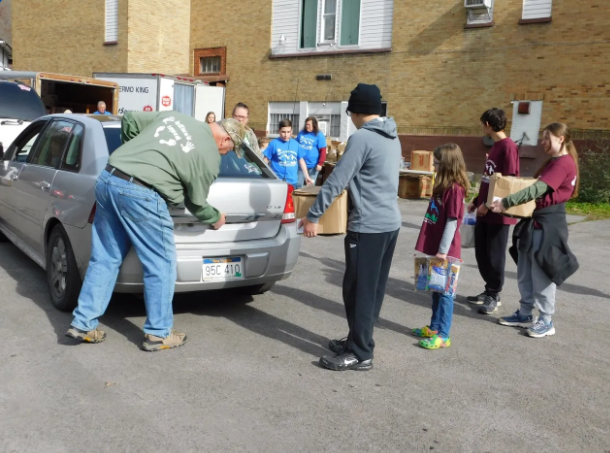
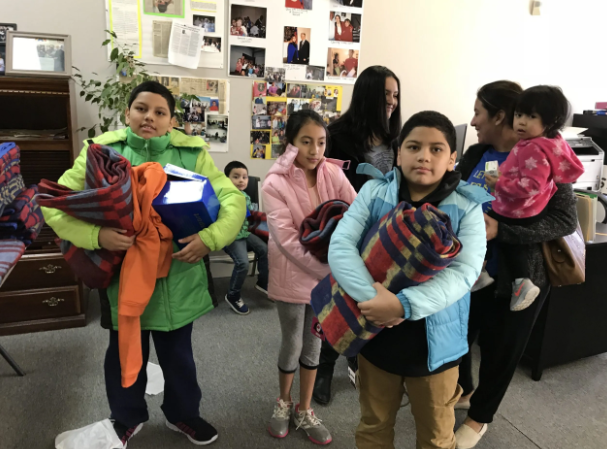
In addition to our educational support, home rehabilitation, and basic needs programs, food security remains at the top of our priorities, especially in the current economic time which is impacting even more harshly those living in the distressed Appalachian communities served by Americans Helping Americans®.
In 2025, thanks to our generous supporters across the country, we were able to ship 18,648 food boxes containing enough food to feed a family of four for a week to our grassroots Appalachian partners. To meet the increasing need for the coming year, our goal is to ship 28,200 boxes.
For example, in distressed McDowell County, West Virginia, Dyanne Spriggs, executive director of our partner there, Big Creek People in Action (BCPIA), explained that the hundreds of food boxes it receives annually from Americans Helping Americans® are a big help to those families and elderly residents who have to count every penny to stretch their food dollars.
And she wants the supporters of Americans Helping Americans® to know they are making a big difference in her small, tight-knit community.
“It’s always nice to get the food boxes from you all because then we can maybe tie it to an event we’re having and serve lots of people.”
Dyanne also noted that the people who come to BCPIA for food boxes are those who work at “very low-paying jobs, many grandparents who are raising their grandchildren, and families who receive food stamps but need extra food.
“It is the people who are simply trying to provide for their families.”