Throughout Appalachia, families living month-to-month or week-to-week struggle to get by working minimum wage jobs or relying on meager fixed incomes and government assistance to keep their children and themselves from going hungry.
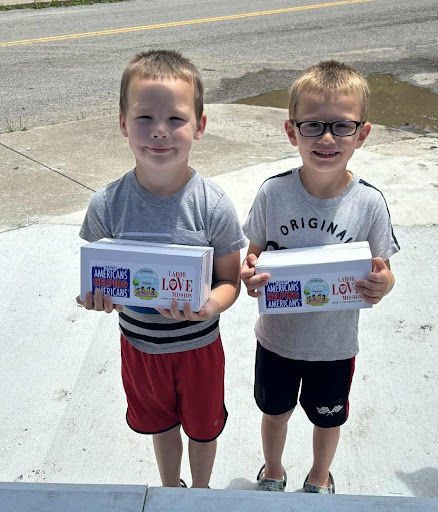
“For the past three years, Americans Helping Americans® has been distributing 10,000 food boxes to our community partners yearly,” notes Americans Helping Americans® Executive Director Cameron Krizek. “This support is greatly appreciated!”
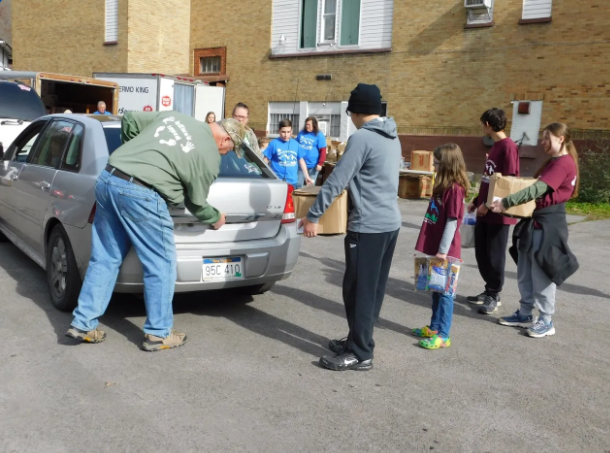
Last year, Americans Helping Americans® shipped 10,000 food boxes to our partners in Georgia, Kentucky, Maryland, North Carolina, New York, Tennessee, and West Virginia for distribution to the most needy in their communities, and this year, Cameron has the goal of increasing the number of boxes to 15,000.
Cameron explained that our partners can use the food boxes, at our cost of $36, which can provide meals for a family of four for up to a week, to supplement their food bank, tie them into other in-kind distributions (such as school supplies or winter coats), “or create their own event the community can participate in.”
Items in a typical recent food box include canned chili, spaghetti & meatballs, green beans, and diced tomatoes, beef tamales, tuna, applesauce, fruit cocktail, Mandarin oranges, peanut butter, mac ‘n cheese, rice, almonds, and Farina.
“I work with the partners to determine what foods meet the needs of their community as well,” says Cameron.
Cameron pointed out that annual shipments are made quarterly; however, “COVID-19 benefits ran out last year, and I expect more aid will be required.
“Families on SNAP (Supplemental Nutrition Assistance Program) used to get $200 for monthly food benefits, but that has been greatly reduced, and food prices have gone up,” he said, proposing six such shipments for 2024.
“This additional aid will ensure the most vulnerable are cared for.”
Among those recipients who utilized their food boxes uniquely and educationally last year was the Friendship Central School in Allegany County, in Appalachian New York state. It used the food boxes it received to host a cooking demonstration that created recipes with the contents.
The school received 336 boxes, and instead of simply handing out the boxes to the hundreds of needy school families, FCS staff member Jacqueline Dent informed us that they offered cooking demonstrations using the foods included in the box.
Families gathered in the school's cafeteria at its “Good Food Fest,” where they learned how to make meals, including chicken gravy over rice with veggies, tuna noodle casserole, salmon patties and beans, and more.
“Every meal at the event was made with the foods in each box,” said Jacqueline.
In addition to the cooking demonstrations, attendees at the free all-ages FCS event took part in a buffet-style taste testing, and at the conclusion, every family went home with a food box to use the recipes they learned at the event.
“We are excited and had a great response!” Jacqueline told us.
In distressed McDowell County, West Virginia, Dyanne Spriggs, co-executive director of our partner there, Big Creek People in Action (BCPIA), explained that while they do receive a limited amount of food each month from the U.S. Department of Agriculture, they still have to purchase food it gets from the Mountaineer Food Bank at a slightly reduced cost “it takes all of that food to try to serve our regular customers at the pantry.”
For BCPIA, the hundreds of food boxes it receives annually from Americans Helping Americans® is a big help to those families and elderly who have to count every penny to stretch their food dollars. And she wanted the supporters of Americans Helping Americans® to know they are making a big difference in her small, tight-knit community.
“It’s always nice to get the food boxes from you all because then we can maybe tie it to an event we’re having and serve lots of people.”
Dyanne comments that the people who come to BCPIA for food boxes are those who work at “very low-paying jobs, many grandparents who are raising their children, and families who receive food stamps but need extra food.
“It is the people who are simply trying to provide for their families.”
As for Cameron, who predicts the need for even more food box shipments this year, “With safety nets failing, we see our most vulnerable, children and the elders, at a greater risk of suffering from hunger.”