
No child in America should have to worry about where their next meal will come from. Yet for millions of families, this uncertainty is a daily reality. Child hunger in the U.S. continues to affect children’s health, academic success, and long-term stability.
Food insecurity means a household lacks consistent access to enough food for an active, healthy life. Hunger is the physical condition that occurs when a child does not get enough to eat. While hunger is often the most visible sign, food insecurity is the underlying issue that places children at risk.
According to the latest USDA data from 2024, 18.4% of U.S. households with children, nearly 1 in 5, experienced food insecurity. That year, 7.3 million children experienced food insecurity themselves. These child hunger statistics in America reflect a widespread problem affecting communities across the country.
Although child hunger in the U.S. is a national crisis, its impact is especially severe in regions like Appalachia. Persistent poverty, limited access to grocery stores, and transportation barriers create unique challenges for families already struggling to make ends meet.
For over 30 years, Americans Helping Americans® has been committed to easing this suffering by providing food assistance and long-term support to families and children in Appalachia.
2024 Child Hunger Statistics in America
Understanding child hunger in the U.S. requires looking at the most recent verified data and what current research indicates about where the crisis is heading. The most recent federal data shows that food insecurity among children remains widespread and has not improved.
Official 2024 Data: The Most Recent Picture
The latest complete data from the USDA provides the clearest snapshot of child hunger nationwide. Key findings include:
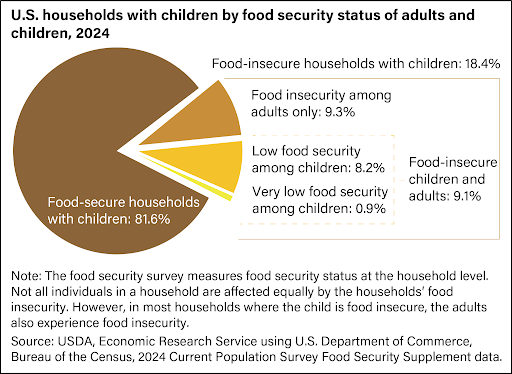
USDA pie chart displaying food insecurity stats of adults and children in 2024
- 18.4% of households with children, or 6.7 million households, were food insecure.
- 9.1% of households with children, or 3.3 million households, experienced food insecurity that directly affected children, not just adults.
- 0.9% of households with children, or approximately 318,000 households, faced very low food security among children, meaning children’s eating patterns were disrupted and food intake was reduced.
These figures show that millions of children live in homes where consistent access to food is uncertain or inadequate.
The 2024 Outlook
The 2024 USDA report confirms that child hunger in the U.S. is not improving. Food insecurity held at 13.7% of all households, essentially unchanged from 13.5% in 2023 and well above the rates near 10% seen in the late 2010s. Among households with children, the rate was higher still at 18.4%.
This 2024 report is also the final one of its kind. After three decades of annual reporting, the USDA has announced it will discontinue the Household Food Security report, removing the country's most reliable measure of hunger going forward.
That loss of consistent federal data makes the on-the-ground work of Americans Helping Americans® more critical than ever to understand community needs and respond directly to child hunger.
What Are the Main Causes of Child Hunger?
Child hunger in the U.S. is not caused by a lack of food. It is driven by structural and economic factors that limit a family’s ability to consistently access nutritious meals. The causes below explain why millions of children remain at risk.
Poverty and Low Wages
Poverty is the strongest predictor of child hunger. When parents work low-wage or unstable jobs, income often falls short of covering basic needs like housing, utilities, transportation, and food. According to federal data, households with children experience higher rates of food insecurity than those without children, even when adults are employed. Rising living costs, especially for rent and groceries, further strain family budgets and leave food as one of the first expenses to be reduced.
End of Pandemic-Era Support
Temporary programs introduced during the COVID-19 pandemic played a significant role in reducing food insecurity among families with children. Expanded child tax credits, emergency SNAP benefits, and universal school meals helped stabilize household food access. Since many of these supports ended in 2022 and 2023, families have faced a sharp increase in food hardship. Research from the USDA and academic institutions shows that child food insecurity rose soon after these programs expired.
Systemic Inequities
Child hunger disproportionately affects families already facing systemic barriers. Households led by single parents, families of color, and those living in historically under-resourced regions experience higher rates of food insecurity. Longstanding inequities in wages, education, housing, and health care increase vulnerability and reduce access to safety nets. These disparities are well documented by federal agencies and research organizations studying poverty and food access.
Lack of Access
Even when families have some income, access to food can still be a challenge. Many rural and low-income communities lack nearby grocery stores, affordable transportation, or reliable food distribution networks. This is especially true in parts of Appalachia, where families may live far from supermarkets and rely on limited local options. Studies from the USDA and regional development agencies show that food deserts and transportation barriers significantly increase the risk of child hunger.
Who Is Most Affected by Food Insecurity?
Food insecurity does not affect all households equally. Certain families and regions face significantly higher risks due to income instability, caregiving responsibilities, and geographic barriers.
By household type, families headed by single parents experience the highest rates of food insecurity. Households led by single women face food insecurity at a rate of 36.8%, while households led by single men experience a rate of 23.8%. These families often rely on a single income while balancing childcare, housing, and medical costs, leaving little flexibility when expenses rise.
Using the USDA's 2022–2024 three-year average data, rates range from a low of 9.0% in North Dakota to a high of 19.4% in Arkansas. According to the USDA, six states have food insecurity rates statistically higher than the national average: Arkansas, Kentucky, Louisiana, Mississippi, Oklahoma, and Texas. Many of these states also have large rural populations and higher poverty rates, which increases the risk for children.
The Crisis in Appalachia: A Deeper Look at Child Hunger
Child hunger in the U.S. is especially severe in Appalachia, where long-standing economic challenges intersect with geographic isolation. High poverty rates, limited job opportunities, and the decline of industries such as coal and manufacturing have left many families with fewer pathways to stable income. At the same time, rural terrain and underdeveloped infrastructure make access to grocery stores, food pantries, and support services more difficult.
This crisis is intensified in rural areas. The USDA reports that 15.9% of rural households experience food insecurity, a higher rate than suburban households and comparable to urban levels. For families with children, these challenges are compounded by transportation barriers and fewer school-based nutrition resources.
According to the Appalachian Regional Commission, 14.3% of Appalachian residents still live in poverty, and the region’s median household income is only 82% of the national median. Child poverty rates in the region also exceed national levels. While the national child poverty rate was 16.0% in 2023, Appalachian states such as West Virginia and Tennessee reported rates of 17.0% or higher.
These realities explain why Americans Helping Americans® focuses its work on strengthening communities throughout West Virginia, Georgia, Tennessee, and Kentucky, where children and families face some of the highest barriers to food security in the country.
The Lifelong Effects of Childhood Hunger
Child hunger in the U.S. is not a temporary hardship. When children lack consistent access to nutritious food, the effects can last well into adulthood. Hunger disrupts physical development, limits learning potential, and places lasting strain on emotional health. Addressing food insecurity early is critical to protecting a child’s future.
Physical Health
Children who experience hunger are more likely to suffer from poor overall health. Inadequate nutrition weakens immune systems, increases the risk of chronic illness, and can slow physical growth and development. Hunger during early childhood is also linked to higher rates of hospitalizations and long-term health conditions that persist into adulthood.
Academic Performance
Food insecurity directly affects a child’s ability to learn. Children who are hungry struggle with concentration, memory, and problem-solving, which can lead to lower test scores and delayed academic progress. Hunger is also associated with higher absenteeism and behavioral challenges in school, limiting opportunities for long-term educational success.
Mental & Emotional Health
The stress of food insecurity can take a serious toll on a child’s mental and emotional well-being. Children living in food-insecure households experience higher rates of anxiety, depression, and emotional distress. This ongoing stress affects self-esteem, social development, and coping skills, increasing the risk of mental health challenges later in life.
How to Help Child Hunger
If you are searching for how to help child hunger, the most effective solutions are direct, reliable, and community-driven. Families facing child hunger need solutions that provide food now while also strengthening long-term stability. Through programs that deliver reliable meals, fill seasonal gaps, and respond quickly to community needs, meaningful progress is achievable. This is where our work is focused.
1. Support Direct Food Bank and Food Box Programs
Direct food distribution remains one of the fastest and most reliable ways to support families experiencing food insecurity. In 2025, Americans Helping Americans® shipped 18,648 food boxes to partners across the country, reaching families in rural and underserved communities.
Each box contains 25 pounds of nonperishable food, enough to feed a family of four for an entire week. These boxes are distributed through trusted local partners who understand the needs of their communities and ensure food reaches children quickly.
A single $24 donation can provide one of these food boxes to a family in need. You can learn more about how this work happens through our food bank support program.
2. Fund Summer and Holiday Meal Programs
Child hunger increases during predictable gaps when school meals are unavailable. Summer and holiday breaks are especially challenging for families who rely on free or reduced-price school lunches.
When school is out, many children lose their most reliable source of daily nutrition. Our Summer Food Program delivers nutritious lunches directly to children in rural areas, while our support for free summer camps provides safe spaces where children receive regular meals and supervision.
Holidays create a second hunger gap. In the 2024 holiday season, we provided $32,500 in grant funding to partners in Tennessee, Kentucky, and Georgia. This support helped ensure that thousands of families could enjoy a Thanksgiving and Christmas meal during a time that is often financially overwhelming.
3. Make a Monetary Donation
Monetary donations are one of the most effective ways to fight child hunger. Financial support allows us to purchase food in bulk at lower prices, reduce transportation costs, and respond quickly to urgent needs identified by our partners. This flexibility helps every dollar go further.
All contributions to Americans Helping Americans® are fully tax-deductible to the extent allowed by law. If you are looking for a direct and meaningful way to help child hunger, you can donate today to support children and families in Appalachia and help ensure families have access to the food they need.
Stories of Impact: "A Welcomed Blessing"
Behind every statistic is a family, a child, and a moment of relief when help arrives. Hearing directly from those we serve shows how food assistance changes lives in tangible ways.
“Because of you all at Americans Helping Americans®, my family was able to have a wonderful Thanksgiving!”
– Crystal from Lee County, KY
Holiday meals provide more than food. They offer stability during a time of year that can be especially stressful for families already struggling to make ends meet.
“After receiving 924 food boxes, Jackie Dent from Friendship Central School in New York called them ‘a welcomed blessing’ for the families of students.”
These stories reflect the strength of our nationwide network of partners, which includes schools, food banks, community organizations, and local leaders. By working together, we are able to reach children and families across multiple states and respond quickly when communities need support most.
You Can Be the Solution to Child Hunger
Child hunger in the U.S. affects an estimated 7.3 million children. The scale of the problem is significant, but the solution is not abstract. It is practical, achievable, and already happening through targeted programs that deliver food where it is needed most.
This is not just a statistic. It is a child in rural Tennessee who depends on a school lunch to get through the day. It is a family in Kentucky choosing between groceries and utility bills. It is a community in Appalachia where access to food can determine whether a child stays healthy and focused in school.
At Americans Helping Americans®, we see the impact of timely food assistance every day. With continued support, we can expand food box distributions, fill summer and holiday hunger gaps, and strengthen the local partners who know their communities best.
If you are ready to be part of the solution, we invite you to donate today to support children and families in Appalachia and help ensure that no child goes without the food they need to grow and thrive.